
· Ewan Hartley
What is a safety razor?
Most of the confusion around these razors is vocabulary rather than technique. Cap, base plate, comb, bar, gap, exposure: half a dozen words describing an object with three pieces. Here is what each one means, and what it changes.
The object itself
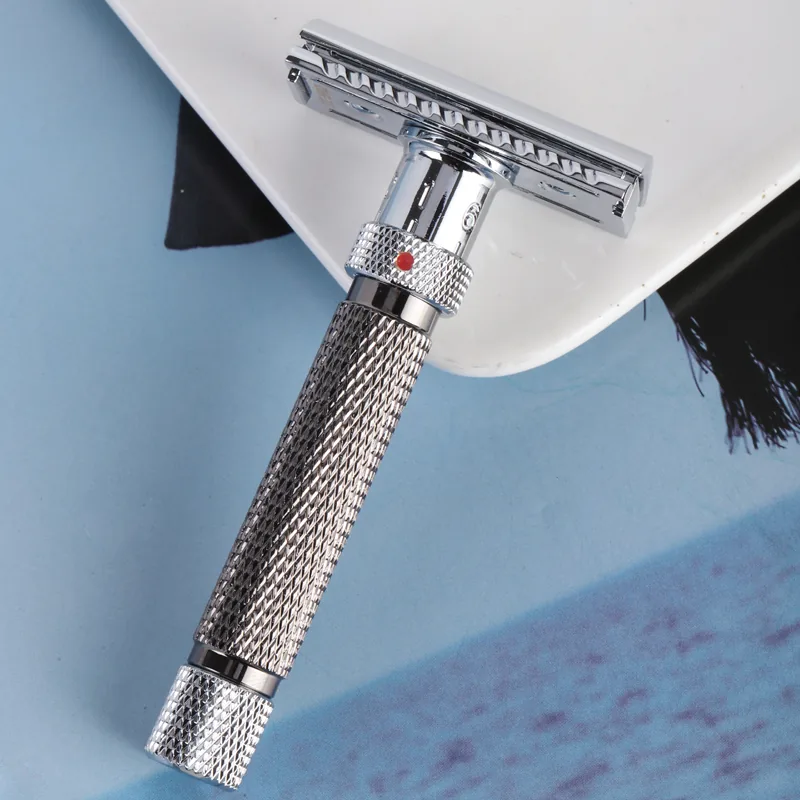
Pick one up and it is heavier than you expect. Ours is 81 grams in a shape about the size of a toothbrush, and most of that mass sits in the head rather than the handle. That distribution is not decoration. A head-heavy razor drops into the stroke on its own, so the cutting force comes from the metal and not from your wrist.
The head is a metal sandwich. A blade lies flat inside it, clamped between a top piece and a bottom piece, with only a sliver of each long edge standing proud on either side. Look at it from the front and you are looking at a straight line of steel with a metal lip running underneath. That lip is what everything else on this page depends on.
Undo the handle and the whole thing comes apart in your hand, in three pieces, with the blade loose in the middle. There is nothing sealed, nothing glued, and nothing that wears out except the blade. It is the simplest object in a bathroom, which is why the design has not needed changing.
Where the safety in the name comes from
The razor that came before this one held an open blade. Nothing stood between the edge and the skin except the hand holding it, and the angle was entirely the shaver's problem: too steep and the edge bites in, too shallow and it skids.
A safety razor solves that mechanically. The bottom piece of the head projects slightly further than the blade does, so the metal touches your face before the steel can. It sets the angle for you, it stops the edge from digging in when your hand tilts, and it decides in advance how deep a stroke can go. The name is a description of that one feature, not a claim about how careful you have to be.
What it does not do is remove the need for a light hand. The lip governs depth; it does nothing about pressure, and pressure is what causes irritation. That part stays with you, and it is covered in our guide on how to use a safety razor.
The three parts, and what each one does
Almost every safety razor made is three pieces, and knowing which is which makes every product description on the internet readable.
The cap is the top piece. It carries a post down through the middle of the blade and gives the head its curved upper surface, the one that rests against your cheek. The curve is what you are feeling for when you tip the razor into position.
The base plate is the bottom piece, and it is the one that matters. Its front edge is the lip described above, and how far that lip stands out relative to the blade decides whether the razor is mild or keen. Every difference in feel between two razors comes from this piece.
The handle screws up into the cap and clamps the sandwich shut. Its job is weight and grip, in that order. Ours is brass, 77 mm long and 12 mm across, knurled the whole way down, because the only condition a razor handle is ever used in is wet and covered in lather.
| Part | What it is | What it decides |
|---|---|---|
| Cap | Curved top piece, carries the post | The surface you rest against your face |
| Base plate | Bottom piece, with a comb or a bar at the front | How much blade reaches your skin |
| Handle | Screws up into the cap and clamps the head | Weight, and grip when wet |
| The blade | Flat, replaceable, sits between the two | Nothing. It is the same blade in every razor. |
Handle and weight figures from the product specification, 2026.
What double edge actually means
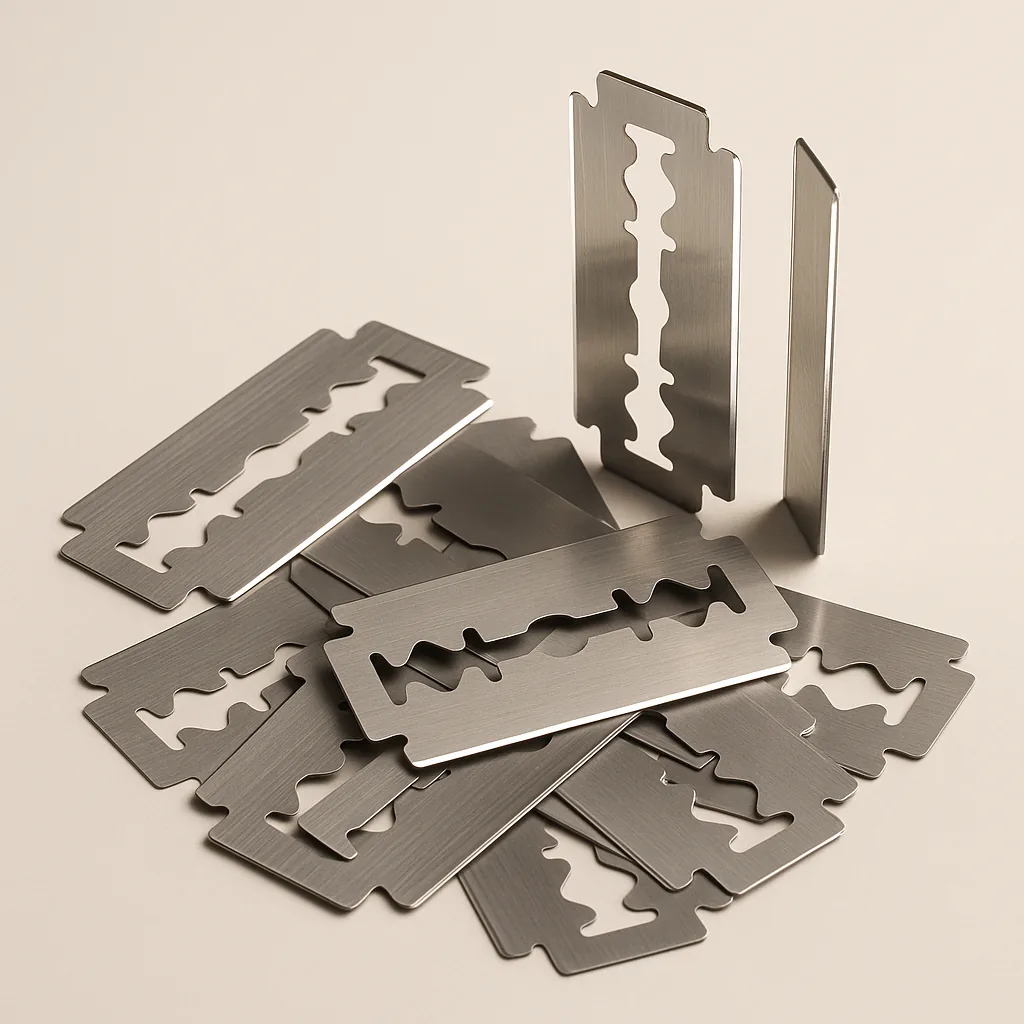
It means what it says: the blade is sharpened along both long sides. One rectangle of steel, roughly the size of two postage stamps, with a cutting edge top and bottom and a shaped slot through the middle that locates it on the post in the cap.
Two edges is a convenience rather than a feature. You shave with whichever side is facing the way you are moving, and the razor uses both because the head is symmetrical: it cuts on the down stroke on one side of your face and on the other side going the other way. Nobody flips the blade halfway through its life to get a fresh edge, because both edges wear at the same rate anyway.
The size has been standard for about a century, which is the genuinely useful part. Any double-edge blade fits any double-edge razor, so the handle you buy today is never tied to one shape of refill. Ours takes any of them, and there is more on which ones and how long they last on our safety razor blades page.
Open comb, closed comb, and the bar
This is the one piece of jargon that stops people reading a product page, and it refers to the front edge of the base plate.
An open comb has teeth, with gaps between them, so lather and cut hair pass through instead of building up in front of the blade. It suits long growth and it exposes a little more edge, because between the teeth there is nothing under the blade at all.
A closed comb, usually called a safety bar, is a continuous strip of metal instead of teeth. It is often scalloped or grooved along its length, which is what ours is: run a finger under the cap and you feel a ridged bar rather than a row of gaps. A continuous bar holds a flatter, more even line against the skin and is the more forgiving of the two.
The practical difference between them is smaller than the amount written about it, and our guide to choosing a safety razor puts it below weight and adjustability for that reason. If you are reading this to work out what to look for first, look at the weight.
Blade gap and exposure
Two more words, and they are the ones the comb debate is really about. Gap is the distance between the underside of the blade and the top of the bar. Exposure is how far the edge stands proud of the line running from the cap to the bar.
A small gap and low exposure give you a razor that is hard to hurt yourself with and that takes two passes to get properly close. Open both up and the razor cuts more per stroke and forgives less. Neither is better. They suit different faces, different growth and different mornings, which is the awkward part of buying a fixed razor: the numbers are almost never published, so you find out what you bought by shaving with it.
Adjustable and fixed razors
A fixed razor has one gap, machined in, permanent. An adjustable razor puts the base plate on a threaded collar so it can move relative to the cap, which changes the gap and the exposure together. Turn the collar to a low number and the blade retreats; turn it up and more edge comes out.
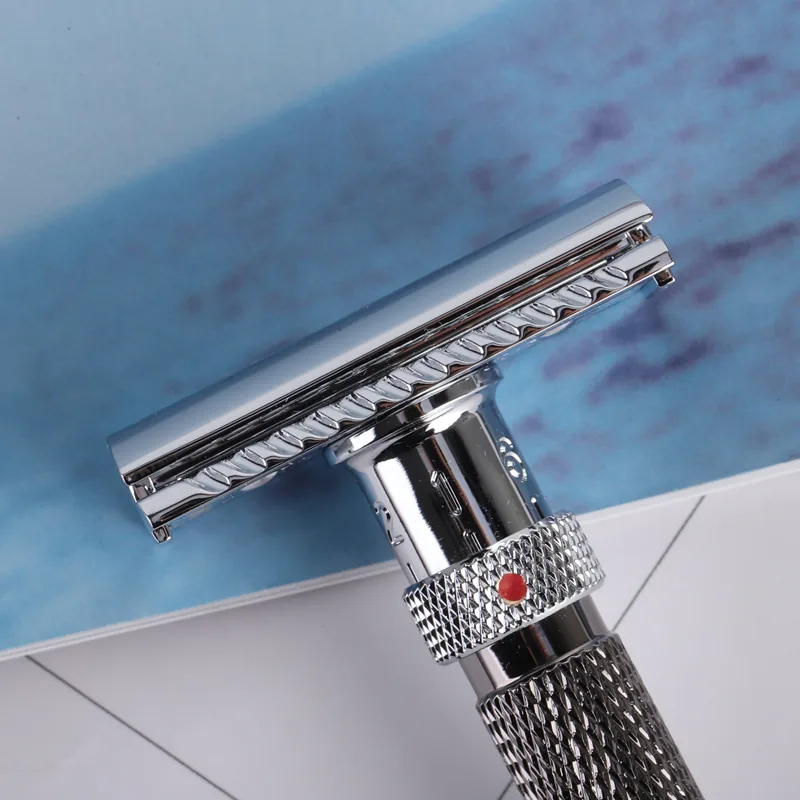
That is the whole mechanism, and it is why we build only that kind: one razor covers the range a shelf of fixed models would cover, and you find your setting after you own it rather than guessing at it. The detail lives on our adjustable safety razor page, and the razor itself is at the front of this site.
What changes at the sink
Three things, and none of them is difficulty. The head does not pivot, so you set the angle rather than being given one. You take two light passes where a multi-blade cartridge takes one firm one. And you stop pressing, because 81 grams of brass and chrome is already applying all the force the job needs.
The trade is about a minute a morning while the habit forms, against a blade that costs about five cents instead of a cartridge that costs a few dollars, and a head that puts one edge across your skin instead of several. We have written that comparison out in full, with the five-year arithmetic, in safety razor or cartridge razor.
The vocabulary, in one place
| Word | What it means |
|---|---|
| Double edge (DE) | A blade sharpened on both long sides. One standard size worldwide. |
| Three-piece | Cap, base plate and handle come fully apart. Most razors, including ours. |
| Two-piece | Base plate is fixed to the handle. One fewer part to drop in the sink. |
| Butterfly or twist-to-open | The cap splits open on a hinge when you turn the handle, so the head stays assembled. |
| Open comb | Toothed front edge on the base plate. Passes lather and long growth. |
| Closed comb / safety bar | Continuous strip instead of teeth. Flatter against the skin, more forgiving. |
| Blade gap | Distance between blade and bar. Bigger gap, keener shave. |
| Exposure | How far the edge stands proud of the cap-to-bar line. |
| Adjustable | Gap and exposure move on a numbered collar rather than being machined in. |
| Pass | One complete trip over the face. Two light ones beat one hard one. |
Questions people ask
Is a safety razor the same thing as a double-edge razor?
In everyday use, yes. Safety razor describes the guarded head, double edge describes the blade it holds, and almost every razor sold under either name is both. Our double-edge safety razor page covers the blade side of it.
Why is it heavier than the razor I have now?
Because the weight is doing the cutting. A plastic handle needs you to push; 81 grams of brass and chrome falls into the stroke on its own, and removing the reason to press is most of what makes a double-edge shave comfortable.
Does the blade come with it?
The razor on its own ships without blades. The kit adds a pack of ten, which is about two months of daily shaving, so you can shave the day it arrives.
How long does the razor last?
Decades. Only the blade is consumable, and you change it when it starts to tug rather than glide, usually after five to seven shaves. There is a fuller answer in how often to change a blade.
Can I take one apart without touching the edge?
Yes. Unscrew the handle, lift the cap, and the blade sits flat in the base plate to be tipped out. The post is long enough that you line the blade up by its slot rather than by its edge.
What do the numbers on the collar mean?
They are gap settings, low to high. One exposes the least blade and is where to start; most buyers of ours settle at two and stay there. They are engraved with a red index mark so you can always see where you left it.
Setting figures from our own verified buyer reviews, 38 ratings, 2026.

Ewan Hartley · Editor, Kelvedge
Writes the guides on this site and reads every verified rating the razor receives. Shaves with a double-edge daily, at setting two.