
· Ewan Hartley
Safety razor for women: legs, underarms and the setting to start on
Everything else on this site is written around a face. Legs, underarms and the bikini line ask the same razor slightly different questions, and the dial answers most of them. This is the body version: which setting each area starts on, where the guard stops protecting you, and what changes when the skin under the blade is not a cheek.
The same razor, more skin to cover
Nothing inside a safety razor head knows whose skin it is on. One double-edge blade sits behind a guard bar, and the gap between them meters how much edge reaches you. That geometry cuts leg hair the way it cuts a beard: once, at the surface. The mechanics are counted out in why a single blade razor shaves better, and every line of it applies below the neck.
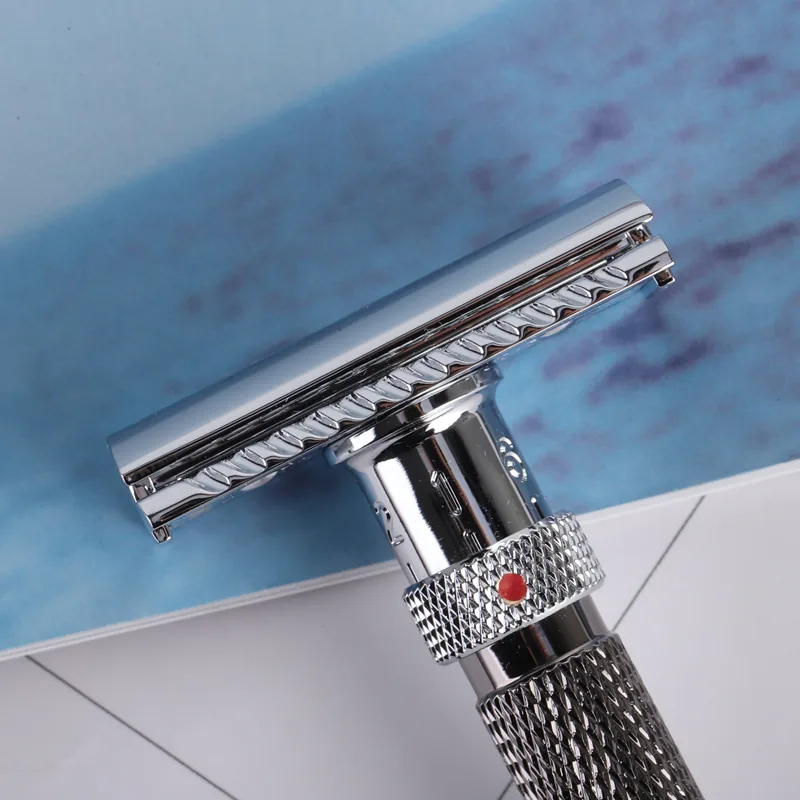
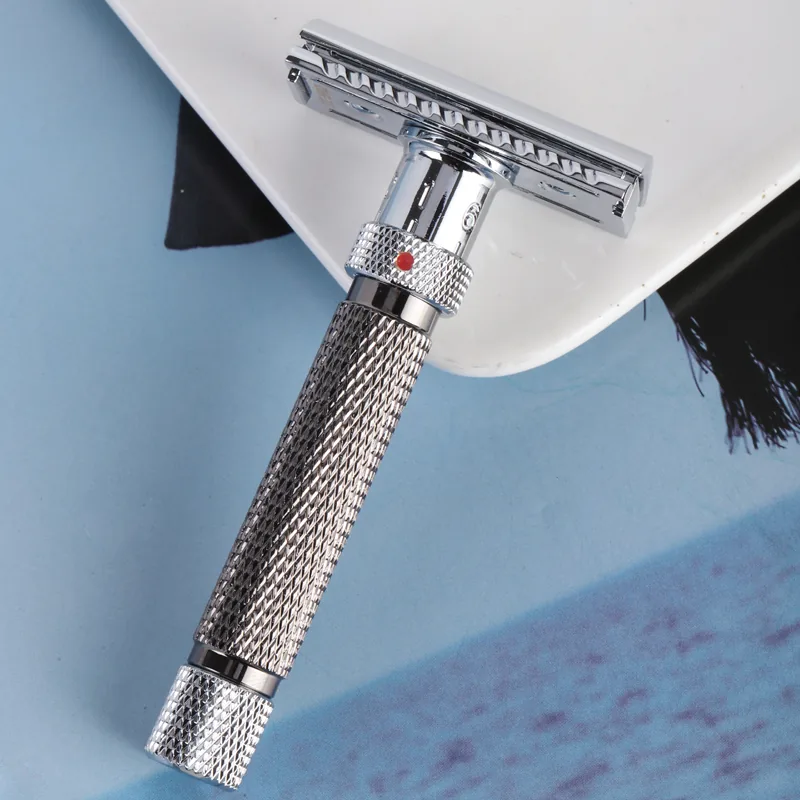
What changes is the amount of skin. A shin is a longer, flatter run than any part of a face; an underarm is a smaller, looser one with hair growing in several directions. The Kelvedge razor weighs 81 grams over 88 millimetres, most of it in the head, and on a long flat stroke that weight does the work: the head drops onto the skin and the stroke runs the length of the shin without your wrist adding anything.
Weight and length figures from the product specification, 2026.
The other difference is the dial. On a face the collar gets set once and left alone. On a body it earns its place every time you move from one area to another, because a shin and a bikini line do not want the same amount of blade, and turning the collar takes two seconds. What the collar physically moves is on the adjustable safety razor page.
The setting to start on
One. The same answer the site gives a first-time face, for the same reason: the lowest number exposes the least blade, forgives a poor angle, and lets you learn the razor before you ask it for closeness. Every area starts there and leaves it at its own pace.
| Area | Start at | After the first fortnight | Why |
|---|---|---|---|
| Legs | 1 | 2, once the angle is automatic | Firm, flat skin and long strokes: the cheek of the body |
| Underarms | 1 | Stay at 1; 2 only if nothing stings the next morning | Loose skin, hair in several directions: the neck of the body |
| Bikini line | 1 | Stay at 1 | Thin, folded skin and coarse hair; with the grain only |
Settings from the range published for this razor, one to four and up, and from our own verified buyer reviews, 38 ratings, 2026.
The reasoning is the one the site already uses for the neck. Where skin is firm and the stroke is long, more blade is comfortable and two becomes the daily setting. Where skin is loose, folds, or carries hair that changes direction, the neck advice applies: drop the dial a setting for that area and shave with the grain. Underarms and the bikini line are the areas where that advice is permanent. If anything stings the morning after, drop the dial one setting and shave with the grain only for a week, exactly as how to use a safety razor says for a face.
Legs: long strokes, and where the guard leaves the skin
Legs are the easiest place on the body to learn a safety razor. The angle is found as on a face: rest the flat of the head against the shin, tip the handle away until the blade just touches, and keep that angle for the whole stroke. On a shin the surface barely curves; on a calf you let the handle roll slightly as the muscle turns.
Find the grain before the first stroke. Leave a day or two of growth, then run the back of your fingers up and down the shin: smooth one way, rough the other, and smooth is with the grain. On most legs that puts the first pass downwards, from knee to ankle, but your fingers settle it rather than a rule. Rinse, lather again, and a second pass across the grain takes what is left down to the surface. Against the grain waits until the angle is automatic.
The guard bar is what makes this a safety razor: it holds the skin flat so that only the metered amount of edge reaches it. On flat skin it does that without help. There are three places on a leg where it cannot, and all three are bone. The knee: bend the leg so the joint itself draws the skin tight, then take short straight strokes, changing direction between strokes rather than steering during one. The ankle bone: the same, with the foot flexed. The front edge of the shin: keep the stroke light and let the head's weight follow the ridge. In all three the razor asks for shorter strokes, never for more pressure.
A single blade does not clog: a double-edge head has one blade with open space around it, so lather passes straight through, and a rinse under the tap every few strokes keeps the edge clean. A day or two of growth is easier to take off than a morning's stubble, because the hair stands up for the blade.
Underarms: hair in every direction, skin that folds
An underarm is the neck of the body. The skin is loose, it folds when the arm is down, and the hair grows in several directions from a small area. The setting is the neck's: one, until nothing stings the next morning.
Raise the arm high enough that the skin flattens on its own. That is the whole trick, and it is the opposite of what a cartridge teaches. With a pivoting head you pull the skin tight with your free hand and press; with a safety razor you do neither. Over-stretching lifts the hair above the surface and cuts it below the skin line when the skin relaxes, which is how an ingrown hair starts. The raised arm gives a flat enough surface; the free hand stays away.
Then map the grain with the back of the fingers. Most underarms grow in at least two directions, so one pass with the grain means one short pass in each direction the hair grows, with lather renewed each time. Short strokes, no pressure, a rinse between them. Three light passes over a small area cost far less skin than one hard pass. The area is small enough to dry out before you have finished, so if the lather has gone by the second direction, lather again.
The bikini line
The skin here is thin, it folds, and the hair is coarse and often curly. Both facts point the same way: setting one, with the grain only, short strokes, and no second pass until the first one has become routine.
Position the skin so it lies flat under the head without your hand pulling it, which usually means changing how you stand rather than stretching anything. Take strokes no longer than a few centimetres, each with the direction of growth, each lifted off the skin before it changes direction, and re-lather between them: dry skin here is where nicks come from.
Coarse, curly hair is exactly the hair an ingrown starts from when it is cut below the surface, because a curled tip has to travel back out through skin. A single blade at a low setting cuts it at the surface and leaves it nowhere to go but up. That describes where the hair is cut, not anyone's skin.
Two plain limits. Take hair long enough to catch the head down to a few millimetres first, because a blade that has to plough through length gets pushed, and pushing is the one thing this razor does not want. And if a nick keeps bleeding, or a patch of skin stays red and sore for more than a couple of days, that is a question for a pharmacist or a doctor, not for a shaving guide.
Blades, and what a leg does to one
Any standard double-edge blade fits this razor, and a blade costs about five cents against two to four dollars for a cartridge head. A leg uses more edge per shave than a cheek, so the gap shows faster there. The five-year arithmetic is in safety razor or cartridge razor.
The blade life this site publishes, five to seven shaves for average growth, is a figure for faces. Two legs are a larger area with more hair, so read the blade rather than counting: a fresh edge is quiet and glides, a finished one catches and you find yourself pressing to compensate. The moment pressure creeps in is the moment to change it, which takes ten seconds. The full test is in how often to change a safety razor blade.
What does cost edges is leaving a wet blade clamped in the head between shaves: rinse the head under a hot tap, shake it out, and stand the razor on its end. Storing and disposing of blades is covered on the safety razor blades page.
Coming from a cartridge
The habits a cartridge trains get in the way more on a body than on a face, because leg shaving is done fast, by feel. Three things change. The head does not pivot: a safety razor holds the angle you give it, so you turn the handle to follow the curve of a calf, and that takes about three shaves. Pressure goes: the head weighs enough that any force from your hand pushes skin up into the blade, so the hand relaxes. And the shave slows down for a fortnight, because passes replace stacked edges, then speeds back up. The month-by-month version, written for a face and just as true for legs, is safety razors for beginners.
The shower question has a different answer on a body. On a face the shower costs you the mirror. On legs there is no mirror to lose and the water softens the hair. Underarms and the bikini line are still easier in front of a mirror, straight after the shower while the hair is soft.
More on this: the adjustable razor itself, and how to choose a safety razor.
Questions women ask about safety razors
Is a safety razor for women different from one for men?
No. The head, the blade and the dial are the same object whoever holds them. What differs is where it is used, which is what the setting per area above is for. A razor that suits a coarse beard at three suits a shin at two and a bikini line at one.
Which setting for legs?
One for the first week, then two, which is where most people stay for a daily shave on flat skin. Go back to one over the knee and the ankle if either stings, and leave it there for the underarms and the bikini line.
Can I use it on the bikini line?
Yes, at the lowest setting, with the grain, in short strokes, on wet lathered skin. It asks the most of your technique, so it comes last in the learning order: legs first, underarms second, then the bikini line once the angle is automatic.
Does one blade shave legs as close as five?
At the surface, yes, and two light passes get there. The extra closeness of a five-blade head comes from cutting hair below the skin line under tension, which is the mechanism ingrown hairs start from. One blade at the surface leaves nothing buried.
Does it come with blades?
The razor on its own ships without blades; any standard double-edge blade fits it, and the version with ten blades in the box lets you shave the day it arrives. Both are on the double-edge safety razor page.

Ewan Hartley · Editor, Kelvedge
Writes the guides on this site and reads every verified rating the razor receives. Shaves with a double-edge daily, at setting two.