
· Ewan Hartley
Why a single blade razor shaves better
None of that is opinion. It is geometry, and it is easy to see once you slow a razor stroke down and look at what each edge is actually doing.
What a razor edge does to skin
A blade does two things on every stroke, and it does not know the difference between them. It severs hair, which is what you asked of it, and it planes the surface it travels across, which you feel an hour later. Skin is not a hard, flat track: it is soft, it deflects under the edge, and it carries the lather, the oils and the top layer of cells that the blade takes with it as it goes.
One pass with one sharp edge removes very little of that surface along with the stubble. The trouble starts with repetition. Each additional edge that crosses the same patch scrapes a surface that has already been scraped, with less lather protecting it each time. What people call razor burn is usually that arithmetic, not any single cut.
So the question that decides comfort is not how sharp the blade is or what the handle costs. It is this: how many edges crossed each square centimetre of your face this morning? A single blade razor is built around keeping that number as low as the shave allows. A cartridge is built around raising it on purpose, for a reason with a name.
Lift and cut: what five blades are actually doing
A five-blade cartridge is not five chances to catch a hair you missed. The blades work as a sequence, and the sequence has a name in engineering: hysteresis. On packaging it is usually translated as lift and cut.
The first edge in the row is not mainly there to cut. It catches the hair and, because the head is already moving, pulls it slightly out of the follicle before slicing through. The hair behaves like a spring under tension. The second edge arrives a fraction of a second later, while the hair is still extended, and cuts it shorter. So do the third, fourth and fifth. When the stroke has passed, the tension releases and the cut hair retracts — and because it was cut while stretched, its tip now sits below the level of the surrounding skin.
That is the entire design brief: a below-the-surface finish from one stroke, with no technique required. Mechanically it does exactly what it promises. The same mechanism is also the cost of the promise: all five of those edges crossed your skin, the later ones on skin the earlier ones had already wiped clean of lather, and the hair itself has been cut somewhere hair does not naturally end — beneath the surface.
A single blade held in a safety razor head does none of this. There is no second edge behind it, so it cannot cut a stretched hair. It severs at the surface, where the hair stands, and any closeness you want beyond that comes from another light pass rather than from tension.
Where ingrown hairs start
An ingrown hair is a mechanical event before it is anything else. A hair cut below the skin line has to travel back up through skin before it reaches open air. Most manage it. But a tip cut under tension is cut at an angle, which makes it sharp, and a curly or coarse hair does not always travel straight: it can catch the wall of the follicle on the way up, or clear the surface and curl straight back into the skin beside it. Either way there is now a sharp object growing where a hair should be.
Two shaving habits make that event more likely, and both are about depth. The first is cutting the hair below the surface, which is what the lift-and-cut sequence is engineered to do on every stroke. The second is stretching the skin tight while you cut, which lifts hair above the surface exactly the way a cartridge's first blade does, with the same below-the-line result when the skin snaps back.
A hair cut at the surface has nowhere to hide. It does not have to find its way out of anything, because it never went below. That is the mechanical reason single blade shaving has the reputation it has around ingrown hairs — and notice the claim is about geometry, not about anyone's skin: where the hair is cut decides where it grows back from.
The arithmetic of edges
Count edge passes, not strokes: the number of times an edge crossed one patch of skin before you rinsed. A shave that covers each area twice — once with the grain, once across it, a common pattern — gives these totals.
| Razor | Edges in the head | Strokes over one patch | Edge passes |
|---|---|---|---|
| Single blade safety razor | 1 | 2 | 2 |
| Three-blade cartridge | 3 | 2 | 6 |
| Five-blade cartridge | 5 | 2 | 10 |
Edge passes are edges in the head multiplied by strokes over the same skin.
Ten passes against two, before anyone presses too hard or goes back over the jaw a third time — and everyone goes back over the jaw. Add that third stroke and the cartridge is at fifteen while the single blade is at three, each of its passes taken on freshly lathered skin at an angle you chose.
The count also explains why the gap between the two designs shows most on the neck. Cheek skin is firm and takes repetition with little complaint. Neck skin is loose, the grain runs in several directions at once, and every extra edge pass there crosses skin that deflects instead of resisting. Halving the passes matters everywhere; on the neck it is the part of the shave you notice first.
One blade wants weight, not pressure
Pressure is the habit a cartridge trains into you. Its head is light, the pivot absorbs whatever force you add, and pressing is the only control you are given. Bring that habit to a single blade and you push skin up into the head, feed more of it to the edge, and turn a cutting action into a scraping one.
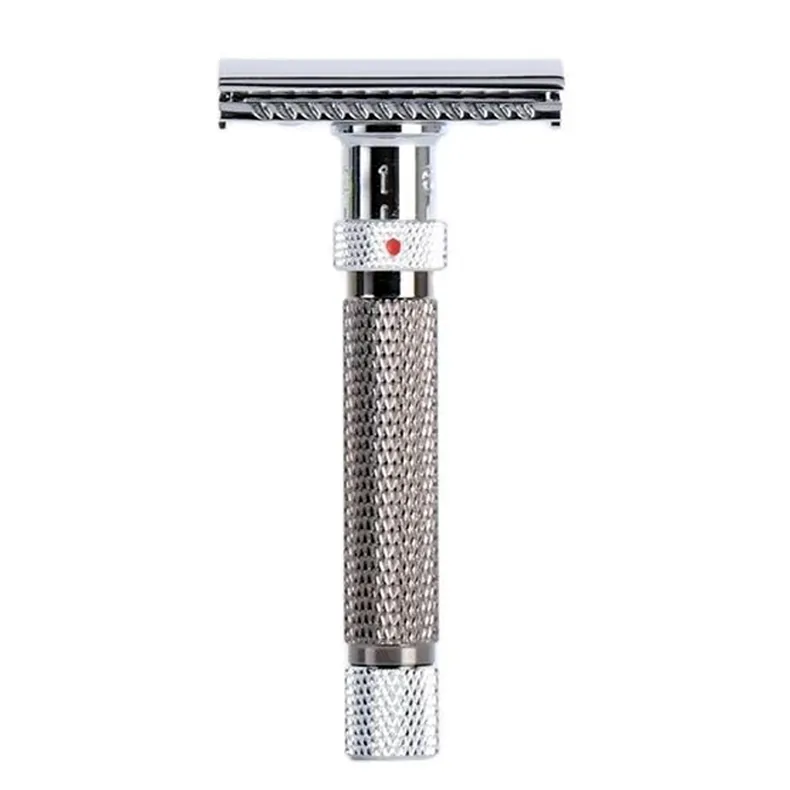
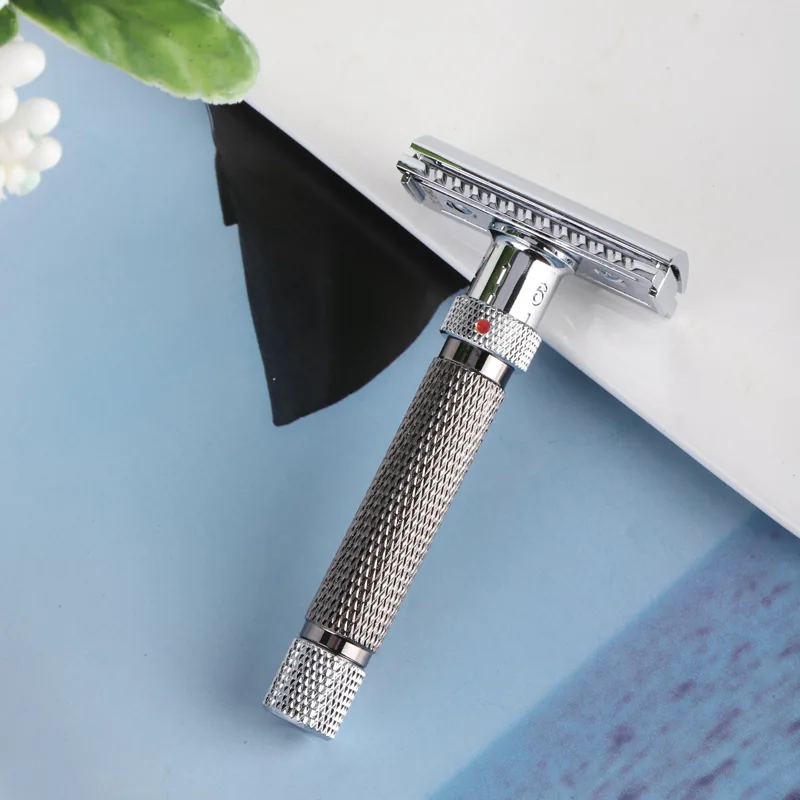
The correction is built into the tool. The Kelvedge razor weighs 81 grams over 88 millimetres, most of it in the head, and that weight is the pressure. You hold the handle lightly, keep the head at roughly thirty degrees, and let it fall through the stroke. A quiet rasp of stubble means the mechanics above are doing their work. Drag means you are pressing, or the blade is finished.
Weight and length figures from the product specification, 2026.
None of this is difficult, but it is different, and the first fortnight is unlearning more than learning. The full routine — mapping your grain, the order of passes, what to do if it stings — is in how to use a safety razor, and the month-by-month version is in safety razors for beginners.
Closeness comes from passes, not stacked edges
The obvious objection: if one blade cuts at the surface, how do you match the below-surface finish of a cartridge? You do not match it — you replace it with something better placed. Single blade shaving works by beard reduction. The first pass, with the grain, removes most of the length. Rinse, fresh lather, and a second pass across the grain takes what is left down to skin level. Two or three light passes, each comfortable on its own, each on protected skin, and the finish sits at the surface everywhere instead of below it in some places.
The real difference between the two approaches is who decides. A cartridge applies its full sequence on every stroke: first stroke or last, cheek or throat, it always lifts and it always cuts low. Passes hand that decision back to you — with the grain only over the temperamental patch of the neck, a second pass on the cheeks, stop when you are satisfied rather than when the design says so.
The dial on an adjustable head extends the same logic. Turn the collar and the blade gap changes: less edge while you learn or for a sensitive neck, more when growth is coarse. One blade does not mean one intensity; it means every pass happens at an intensity you set. What the dial physically moves is covered on the adjustable safety razor page.
If you are coming from five blades
Expect the first three shaves to feel slower — they are, by design, because passes take the place of stacked edges and the angle needs a few mornings to become automatic. Expect closeness to arrive in week two rather than on day one. Blades cost a few cents and change in seconds; the full cost arithmetic over five years, and everything else that changes when you switch, lives in safety razor or cartridge razor.
More on this: the adjustable razor itself, and how to choose a safety razor.
Questions about single blade razors
Is a single blade razor the same as a safety razor?
In practice, yes. Single blade is the principle; a safety razor is the tool that applies it — one double-edge blade clamped in a guarded metal head at a fixed angle. The parts and their names are in what is a safety razor.
Does one blade shave as close as five?
At the surface, yes. The extra closeness of a cartridge comes from cutting below the surface, which is precisely the part this article has been counting against. Two light passes reach skin level; what they never do is leave a sharpened tip buried under it.
Why is the difference most obvious on the neck?
Because the neck combines loose skin, growth that changes direction, and the same number of edge passes as everywhere else. Skin that deflects under the edge gets scraped rather than cleared, so the design that makes the fewest passes has the most to offer there.
Do single blade razors take special blades?
No. Standard double-edge blades have been one shape for a century, fit any safety razor including ours, and cost a few cents each. The differences between them are covered in safety razor blades.
Is a straight razor also a single blade razor?
It is one blade, but nothing limits how much of the edge reaches you, and the angle is yours to hold freehand. A safety razor applies the same single-blade principle inside a guarded head that fixes the angle and meters the exposure — which is the entire reason it is called a safety razor.

Ewan Hartley · Editor, Kelvedge
Writes the guides on this site: choosing, setting and looking after an adjustable double-edge razor.